


In today’s digital landscape, starting an online business is more accessible than ever. With AI-driven tools and modern platforms, you can launch a website, CRM, or ad campaign in days, not months. There is also no shortage of business ideas, which has fueled entrepreneurship across every industry.
Many founders make their first sales through friends and family. That initial traction feels validating, but it often hides a hard truth.
Soon after, growth stalls.
To break through, small businesses turn to marketing, most commonly digital marketing such as SEO and paid search. This is where reality sets in.
🚫 Getting clicks does not mean you are truly “in business.”
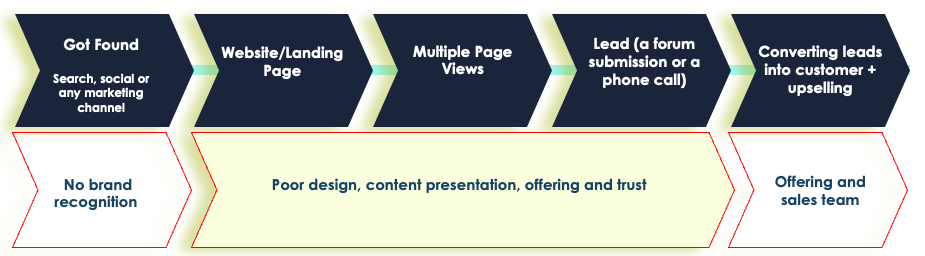
🔁 The Real Challenge: The User Journey
The real challenge is not traffic. It is the user journey.
You are now asking a complete stranger to:
- Trust your brand
- Understand your offer
- Believe you are credible
- Take action with their money or personal information
Friends and family trust you by default. Digital prospects do not.
Winning them requires a deliberate focus on trust, clarity, and user experience (UX).
🧭 Step 1: Understand Your Digital Identity
Website vs. Brand
A common mistake among small businesses is thinking the website is the brand. In reality, they serve different but complementary roles.
🏷️ Your Brand
- Your reputation and identity
- The emotional connection customers associate with you
- Built over time through consistency and credibility
- Focused on long-term trust and recognition
🌐 Your Website
- The functional platform where the brand is presented
- Where users evaluate, compare, and convert
- Focused on usability, clarity, and conversion
Large brands can afford to invest heavily in awareness and familiarity.
Small businesses must prioritize immediate trust and conversion.
🤖 Step 2: Build Trust With Humans and AI Alike
In the era of AI-driven search tools like ChatGPT and Gemini, trust signals matter more than ever.
The good news:
✅ The trust signals valued by humans and AI models are almost identical.
They can be grouped into on-site trust building and off-site trust building.
🧱 Core Trust Signal Categories
| Category | Trust Signal | Impact on Users, Search Engines, and AI |
| 🎨 Professional Design | Consistent look and feel | Signals legitimacy and stability. Helps users feel safe and helps AI classify your brand correctly |
| 📱 UX & Conversion | Mobile-friendly layout and clear CTAs | Improves accessibility, engagement, and conversion rates |
| 🧠 Expert Content | Blogs, videos, podcasts | Builds E-E-A-T and shortens the sales cycle |
| 🔍 Transparency | Clear products and pricing | Reduces confusion and bounce rates |
| ⭐ Social Proof | Reviews and case studies | Demonstrates real-world reliability and reputation |
| 📰 External Validation | Press mentions and partnerships | Increases authority through third-party endorsement |
🏠 On-Site Trust Building
To build authority, often referred to as E-E-A-T (Experience, Expertise, Authoritativeness, Trustworthiness), focus on the fundamentals.
✔️ Professional Design
A clean, consistent design signals care, stability, and legitimacy.
✔️ Transparency
Clear product descriptions, pricing, and expectations reduce hesitation.
✔️ Social Proof
Reviews, testimonials, and case studies provide validation users and AI systems rely on.
✔️ Expert Content
Original insights, research, videos, and podcasts demonstrate real expertise and differentiation.
🌍 Off-Site Trust Building
To meaningfully improve conversion rates, you must build authority beyond your own website.
1️⃣ Establish Expert Authority
Have a trained specialist represent your brand on platforms like Reddit or Quora. Use a professional persona that clearly states credentials and brand affiliation.
2️⃣ Close the Citation Gap
Find high-ranking articles that mention competitors but not your brand. Reach out with a simple inclusion request or offer updated data to replace outdated references.
Traditional link building will also be helpful in this situation.
3️⃣ Partner With Niche Influencers
Focus on trusted educators and subject-matter creators, not mass influencers. Educational, problem-solving content builds credibility faster than promotion.
4️⃣ Optimize for AI Recognition
AI models rely heavily on reviews to assess reputation.
Prioritize Google Business Profile reviews and guide customers to mention specific services. For example, encouraging phrases like “consumer proposals” helps AI accurately summarize what you do.
✅ The Bottom Line
Winning beyond the click means creating an environment where users feel informed, confident, and safe.
When professional branding, strong trust signals, and a seamless mobile-first experience work together, your website stops being just a URL.
It becomes a conversion engine.
About the Author: Wisam Abdulaziz