


Richer SERPs, Fewer Clicks
Search engine results pages (SERPs) are richer than ever. With the rise of AI-generated sections, the traditional “10 blue links” are often reduced to seven or fewer, and they’re capturing far fewer clicks. In this blog, we’ll walk through the evolution of SERPs, especially in the AI era, and share strategies to help you maintain strong SEO performance.
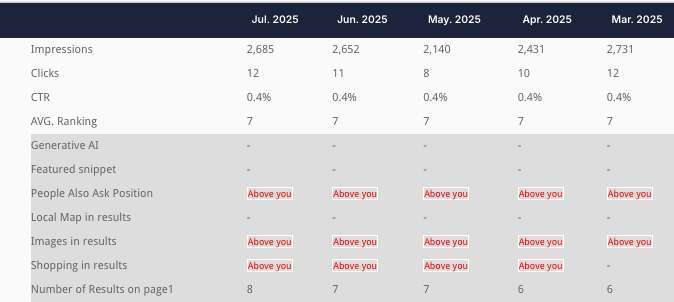
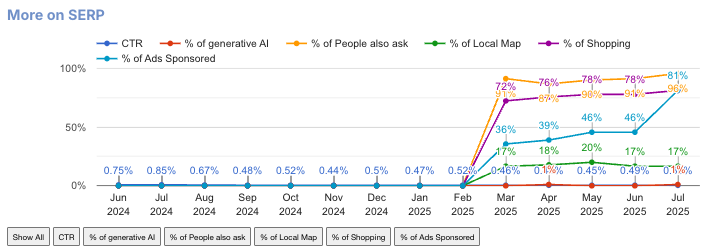
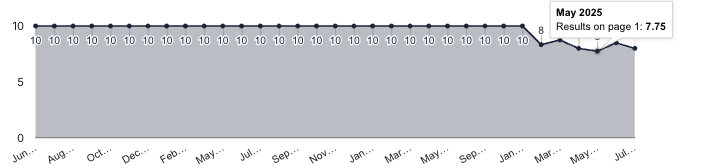
To truly understand keyword rankings today, tracking systems must render the full SERP and analyze all the rich elements on the page ads, AI overviews, product blocks, local packs, and more. Only then can click-through rates (CTR) on organic results be properly understood. See the screenshots below taken from our data warehouse:
Full Keyword Performance SERP Tracking (Including Paid):
Rich Results Analysis Chart:
Average Number of Blue Links on Google’s First Page (Tracking):
The Introduction of Universal Search
Until 2007, Google’s SERPs were almost entirely 10 blue links, with ads displayed on the side. Then came Google Universal Search, which introduced results like maps, images, news, and videos alongside traditional listings.
At that time, rankings were easier to measure and CTRs more predictable. For example, position #1 could deliver 30% CTR. But as Google continued adding new features, including up to four ads at the very top, organic results faced stiffer competition for clicks.
From Universal Search to AI-Powered Search
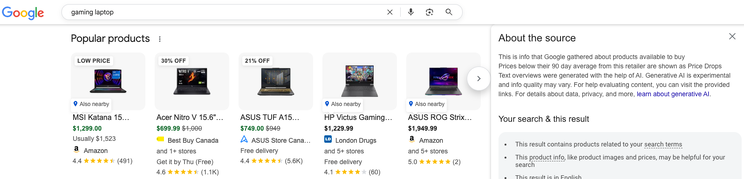
With AI now central to all major search engines, Universal Search has evolved into something even more disruptive. Google has launched AI Overviews, a low-CTR successor to Featured Snippets, along with product blocks for shopping queries that capture even more clicks.
The “10 blue links” era is ending. Our ranking monitors show that for rich SERPs, Google sometimes displays only 7 organic links. Ranking #8 doesn’t even guarantee a spot on page one anymore.
The Rise of Generative Search Engines
Generative search engines (like ChatGPT’s search feature and Google’s experimental AI mode) are still in their early stages, but adoption is expected to grow quickly. At Search Engine People, we’ve already added AI ranking trackers to our systems to prepare for this shift.
Grouping Keywords in an AI-Rich World
In an AI-heavy search environment, marketers must rethink keyword strategies. Some queries will no longer be worth targeting because AI-generated answers replace clicks.
For example, 15 years ago I built a directory for “how many calories in + [food].” Today, those searches are dominated by AI quick answers, often without attribution or links. These are AI-vulnerable keywords that offer little SEO value.
Keyword Intent and AI Risk
| Intent Category | Example | Traditional Search Share | Generative Search Share | No Reference (0-Click) | AI Risk |
| Navigational | Brand name | Very high | Very low | Low | AI Immune |
| Informational | How-to queries | Very high | High | High | AI Vulnerable |
| Transactional | Professional services | Very high | Very low | Low | AI Immune |
| Generative / Creative | Deep research queries | Low | High | High | AI Vulnerable |
Targeting “No-Click” AI-Vulnerable Keywords
Content built around no-click queries can still serve a purpose, educating users, supporting newsletters, or providing social content. But including these keywords in your SEO strategy solely to attract organic traffic is not recommended.
Targeting AI-Immune Keywords
AI-immune keywords (like navigational and transactional queries) will remain highly valuable and should continue to be treated as core SEO targets.
What’s Different About Targeting Generative Search Engines?
The good news: traditional SEO best practices still matter.
The bad news: generative search engines analyze brands more deeply than ever. Rankings won’t just depend on backlinks, they’ll rely on overall brand strength and trust.
Here’s what generative engines can evaluate:
- Reviews across the web: sentiment analysis across multiple platforms
- Customer service: support quality, response rates, and survey feedback
- Financial credibility: company credit reports and perceived stability
- Brand authority: mentions, social presence, backlinks, and overall popularity
When Google first launched, rankings were heavily link-driven, and branding was less critical. Today, however, a strong, trustworthy brand is mandatory to perform well in generative search engines.
About the Author: Wisam Abdulaziz