


Introduction
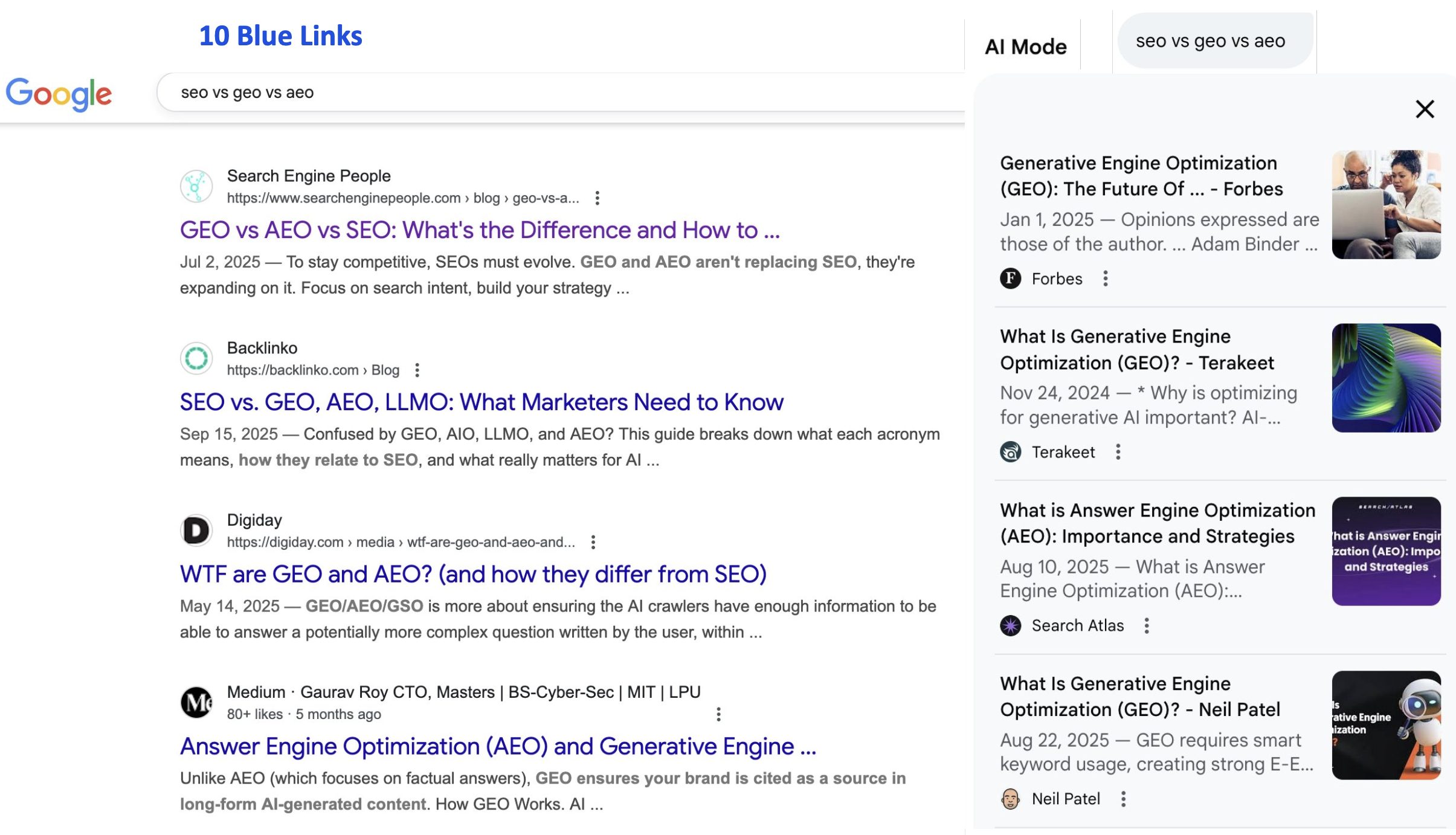
AI search engines like Google’s AI Mode (Powered by Gemini), ChatGPT, and Perplexity are transforming how people discover information. They blend traditional search results with AI-generated summaries, citations, and contextual answers, meaning that what used to be an SEO strategy for “10 blue links” now needs to perform in two layers of visibility:
- Traditional results (10 blue links)
- AI-generated answers (citations & mentions)
Revisit and Readjust Your SEO/GEO KPIs
Traffic remains the lifeblood of a website, but visibility in AI search is the new battleground for credibility and growth. However make sure to communicate with your SEO how much value you want to put on other KPIs like:
- Mentions
- Impressions
- Citation box inclusion
| Shared KPI | Value $ | Traditional Search Engines (Google, Bing, etc.) | AI Search Engines (ChatGPT, Perplexity, Gemini, etc.) | Trackable for AI Search Engines |
| Ranking / Mentions | $ | SERP position (1–10), featured snippets, local pack, rich results | Inclusion in AI answer box, order of citation, prominence in response as a brand mention | Yes for a short list of keywords |
| Impressions | $ | How many times your site appears in search results (Search Console data) | How often your site is surfaced or cited in AI answers | Not yet |
| Traffic from Search | $$$ | Organic sessions driven from search listings | Referral traffic from AI citations, or branded searches triggered by AI mention | Yes |
At Search Engine People, we’ve decided to keep traffic as the main objective. While aiming for traffic, it’s safe to assume that other KPIs, such as impressions, citation inclusion, and mentions, will be covered automatically.
Too Many AI Platforms: Which One Should You Optimize For?
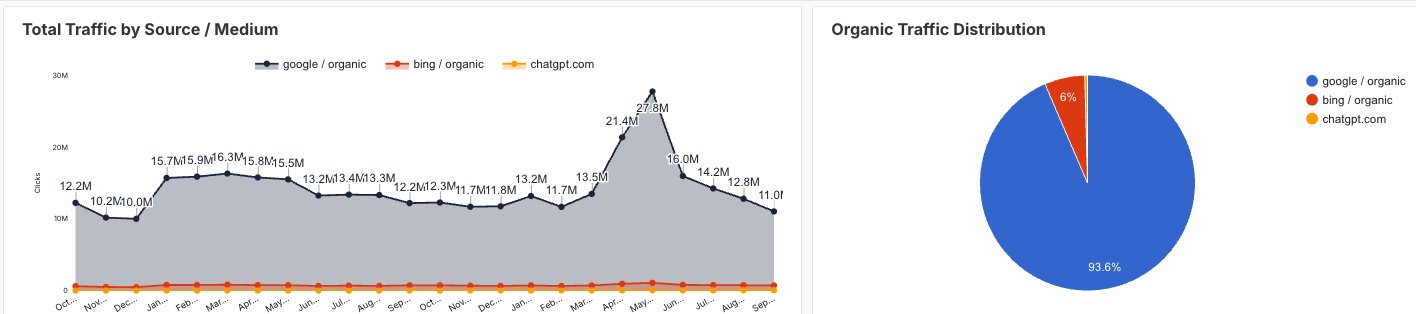
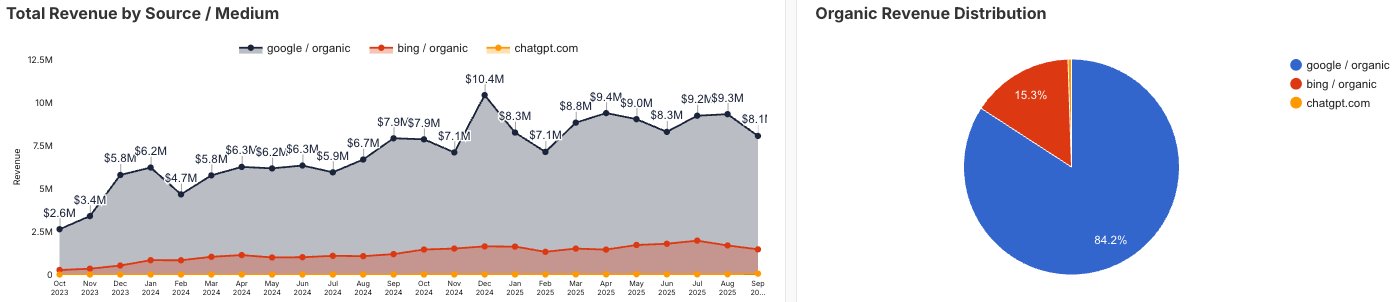
From ChatGPT, Perplexity, and Grok to Google’s AI Mode, this moment feels similar to when search engine market share was once more evenly distributed among Yahoo, Microsoft, AltaVista, Google, and others. It didn’t take SEOs long back then to realize that focusing on Google was enough, optimizing for Google naturally covered Yahoo and Bing as well.
At Search Engine People, we’ve made the decision to continue focusing on traditional Google blue links while adjusting our strategy to perform effectively within Google AI Mode (which could become the default mode in the future). This approach will also position us well across other AI-powered search engines.
For the rest of this post, our strategy adjustments and recommendations will primarily focus on Google AI Mode.
Please be aware that ChatGPT’s impact on traffic, conversions, and revenue is currently less than 1% (based on 200+ GA4 data in our database)
Required Adjustments for Traditional SEO to Work Effectively with AI SEO
1. Adjust Keyword Research for AI Search
Based on our internal data and public studies, transactional/commercial keyword traffic is still largely dominated by Google.
| Intent Category | Google Share | CTR | ChatGPT Share | CTR |
| Navigational (e.g. branded keywords) | 93% | High | 3% | Low |
| Informational (questions ) | 71% | Very low | 23% | Close to 0 |
| Transactional – Services (e.g. yellow pages keywords) | 90% | High | 5% | Low |
| Transactional - Products | 80% | Medium | 10% | Medium |
| Generative/Creative | 29% | Low | 64% | Close to 0 |
SEP recommends avoiding low or no-CTR keywords (0 clicks) when targeting the 10 blue links, unless the keyword is highly strategic for the business. We’ve started calling keywords that do not trigger an AI Overview “AI-immune keywords.”
✅ Action:
- Identify “AI-immune” keywords - those that still attract clicks and have strong CTR potential.
- Conduct AI keyword research to find equivalent queries for ChatGPT. For example, if “SEO company” performs well in blue-link results and Google AI Mode, the ChatGPT equivalent might be “best SEO company in Canada.”
- Develop two content versions for select topics - one optimized for traditional blue-link SEO and another structured for AI inclusion.
- Make sure to add Google AI Mode, blue-link keywords, and ChatGPT queries to your keyword tracking tool. All our clients have free access to these tools through our in-house SEO software.
2. Build Topical Content Hubs and Become a Subject Matter Expert
AI engines and Google both reward subject matter expertise.
A topical content hub groups articles, videos, and resources under one focused topic, strengthening authority and helping AI recognize your brand as an expert source.
To become a subject matter expert and build topical authority, focus on three things: depth, proof, and visibility.
✅ Action:
Pick a niche
Choose a focused topic you are willing to study for years. At Search Engine People, covering all SEO topics may be too broad, so consider choosing a defined subtopic within SEO, such as link building.
Go deep
Learn through real work, experiments, books, and industry content. Document results, wins, failures, and frameworks to explain both what to do and why it works.
Create and organize content
Build pillar pages on your core topic and support them with cluster articles that cover subtopics and common questions. Interlink these pages to form a clear topical structure for search engines.
Show up as the expert
Publish content under your real name, share insights on LinkedIn, speak on webinars or podcasts, and provide expert quotes in industry content. These steps reinforce EEAT signals and help earn authoritative backlinks, strengthening your topical authority.
Content refresh & maintenance
Refresh and expand content hubs monthly using data from AI and blue-link results.
3. Strengthen EEAT Signals (Experience, Expertise, Authoritativeness, Trust)
AI-driven algorithms rely heavily on EEAT signals to decide which brands to cite and feature.
Experience
Show real-world understanding.
- Publish client stories, anonymized case studies, and behind-the-scenes content.
- Create video explainers from real advisors or experts.
- Share proprietary data or research to prove hands-on knowledge.
Expertise
Demonstrate professional credentials.
- Add author bios, photos, and designations.
- Publish detailed guides and tutorials.
- Keep all content compliant and fact-checked by licensed professionals.
Authoritativeness
Earn validation from others.
- Acquire high-quality links and mentions from reputable sources, associations, and review sites.
- Get featured in best-of listicles, local directories, or industry events.
- Highlight awards and partnerships prominently on your site.
Trust
Be transparent and accessible.
- Maintain active social profiles on LinkedIn, Facebook, and YouTube.
- Display authentic client reviews and testimonials.
- Show contact info, compliance badges, and privacy standards clearly.
4. Optimize Off-Page Signals for AI Search
AI search engines weigh off-page credibility as much as on-page relevance.
✅ Action Steps:
- Acquire AI-friendly backlinks: listicles, review sites, and trusted directories that appear in AI citations.
- Partner with influencers and authoritative blogs to generate mentions.
- Maintain positive sentiment through quick review responses and client care visibility.
- Launch quarterly “Review Drive Weeks” to refresh recent reviews and improve recency signals.
5. Move Your User Journey Focus Toward the CMS and CRM
Conclusion
Adjusting your SEO strategy for AI search engines isn’t about starting over, it’s about evolving what works.
Focus on:
- AI-immune keywords
- Citation-targeting strategy
- EEAT-driven authority
- AI-friendly link sources
- Authentic engagement on trusted platforms
The future of SEO belongs to brands that combine credibility, experience, and adaptability. Those who invest in AI-aligned SEO now will own the search landscape tomorrow, both in blue links and AI-generated answers.
About the Author: Wisam Abdulaziz