


Search is changing faster than at any point in the last decade.
Over the past few years, we have built reliable systems to measure SEO performance in traditional search engines. These systems track rankings, visibility across the “10 blue links,” and keyword performance at scale.
With the rise of AI driven search experiences such as ChatGPT, Google Gemini, Perplexity, and Google AI Overviews, a new question has emerged from clients:
How do we measure visibility inside AI generated answers?
Today, we are introducing our answer to that question, a new AI Visibility Measurement system designed to track how brands appear across generative AI platforms.
Why We Built This
Traditional SEO measurement was built around keywords.
We identify a set of high intent “must win” keywords, track rankings across search results, and calculate visibility based on how often a brand appears on page one of Google.
This model still works well for classic search, but AI search behaves differently.
Users are no longer typing keyword lists into AI tools. They are asking questions such as:
- What is the best SEO company in Canada
- Who are the top digital marketing agencies in Toronto
- Which companies are trusted for enterprise SEO
These are conversational prompts and they reflect a shift in how people discover information online.
Instead of tracking hundreds or thousands of keywords, we focus on prompts that reflect real user intent in AI search environments.
What AI Visibility Actually Means
In AI generated answers, brand visibility can appear in three main ways:
1. Brand Mentions
Your company is referenced directly in the AI response without necessarily including a link.
2. Link Inclusion
The AI includes a direct link to your website within the answer.
3. Citations
Your website is referenced as a source that supports the AI generated response.
Together, these three elements define what we call AI visibility.
Unlike traditional search rankings, visibility in AI systems is not only about position. It is about whether your brand is present inside the answer itself.
How the Measurement System Works
Our AI Visibility Measurement system is built on a simple principle.
Instead of tracking every possible keyword variation, we focus on a smaller set of high impact prompts that reflect how users actually search in AI tools.
These prompts are typically structured around intent such as:
- best service in location
- top companies in an industry
- recommended solution providers
We then evaluate how often a brand appears across multiple AI platforms including:
- ChatGPT
- Google Gemini
- Perplexity
- Google AI Overviews and AI Mode
For each prompt, we measure whether a brand appears as:
- A mention
- A citation
- A linked source
This provides a clear view of how visible a brand is across the AI search ecosystem.
Beyond Traditional SEO Tracking
We did not replace our SEO tracking system. We extended it.
Our existing model continues to track visibility across traditional search results including:
- Organic rankings in Google search
- SERP features such as People Also Ask and discussion forums
- Shopping and product blocks
- AI Overviews in Google Search
We have now added a second layer focused entirely on AI generated visibility.
This provides a more complete picture of how brands appear across both traditional and AI driven search environments.
Why Prompts Matter More Than Keywords
One of the key insights behind this system is that AI search is prompt driven rather than keyword driven.
Instead of optimizing for thousands of keyword variations, we focus on a smaller set of meaningful prompts that capture the majority of intent.
The idea is simple.
If a brand is visible in the most important prompts, that visibility tends to extend across related variations.
This approach reduces noise and helps focus on what actually matters, presence in decision making moments.
Multi Model Coverage
AI search is not a single system.
Different platforms generate different responses, so we evaluate visibility across multiple models including:
- ChatGPT
- Google Gemini, including AI Mode
- Perplexity
Each model is assessed separately and then combined into a unified visibility view.
This allows us to understand how brands are represented across different AI systems rather than relying on a single source of truth.
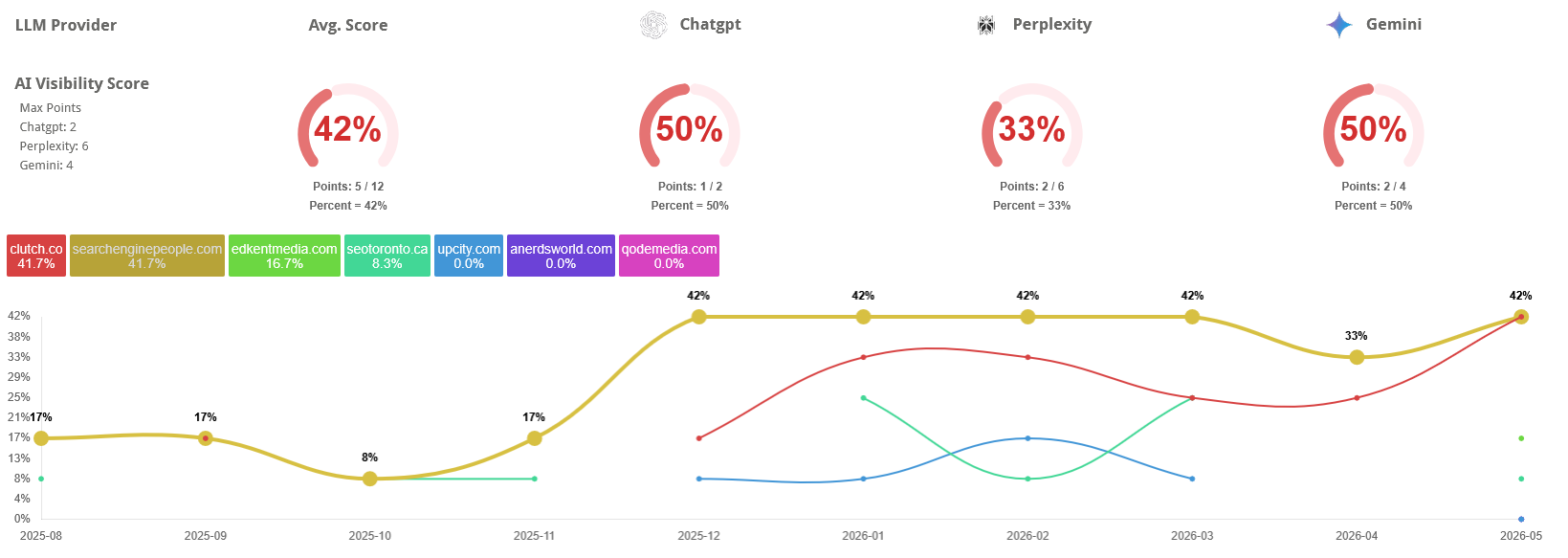
AI Visibility Scoring
To make performance measurable, each prompt is evaluated based on:
- Whether the brand appears
- Whether competitors appear
- Whether the brand is mentioned, cited, or linked
- Which AI model generated the result
This produces a structured visibility score that can be tracked over time in the same way as traditional SEO reporting.
We also evaluate competitive presence to identify where a brand is leading or missing from AI generated answers.
What This Means for Marketing Teams
AI search is quickly becoming a primary discovery layer for users.
As this shift continues, brands need a way to answer new questions such as:
- Are we being mentioned by AI systems
- Are we cited as a trusted source
- Do we appear in AI generated recommendations
- How do we compare against competitors in AI search
This system is designed to bring clarity to those questions using measurable data rather than assumptions.
What Is Next
This is an evolving space.
AI search is changing rapidly and measurement standards are still developing. Our goal is to continue refining this system as platforms evolve and new AI search experiences emerge.
We will also expand coverage and improve how visibility is tracked across different types of AI generated content, including product recommendations and local search results.
About the Author: Wisam Abdulaziz